Answer · Flat roof rooflights
Does a Flat Rooflight Need a Fall?
The short answer
Yes, the roof needs a fall, and the rooflight glass needs a slope of its own. A roof called flat is built with a gentle fall so water runs to the gutter or outlet. The glazed unit must also shed water, so most flat rooflights are made with a slight pitch to the glass, or set on a kerb that gives it one. The maker states the minimum.
Why even a flat roof must slope, and the glass with it.
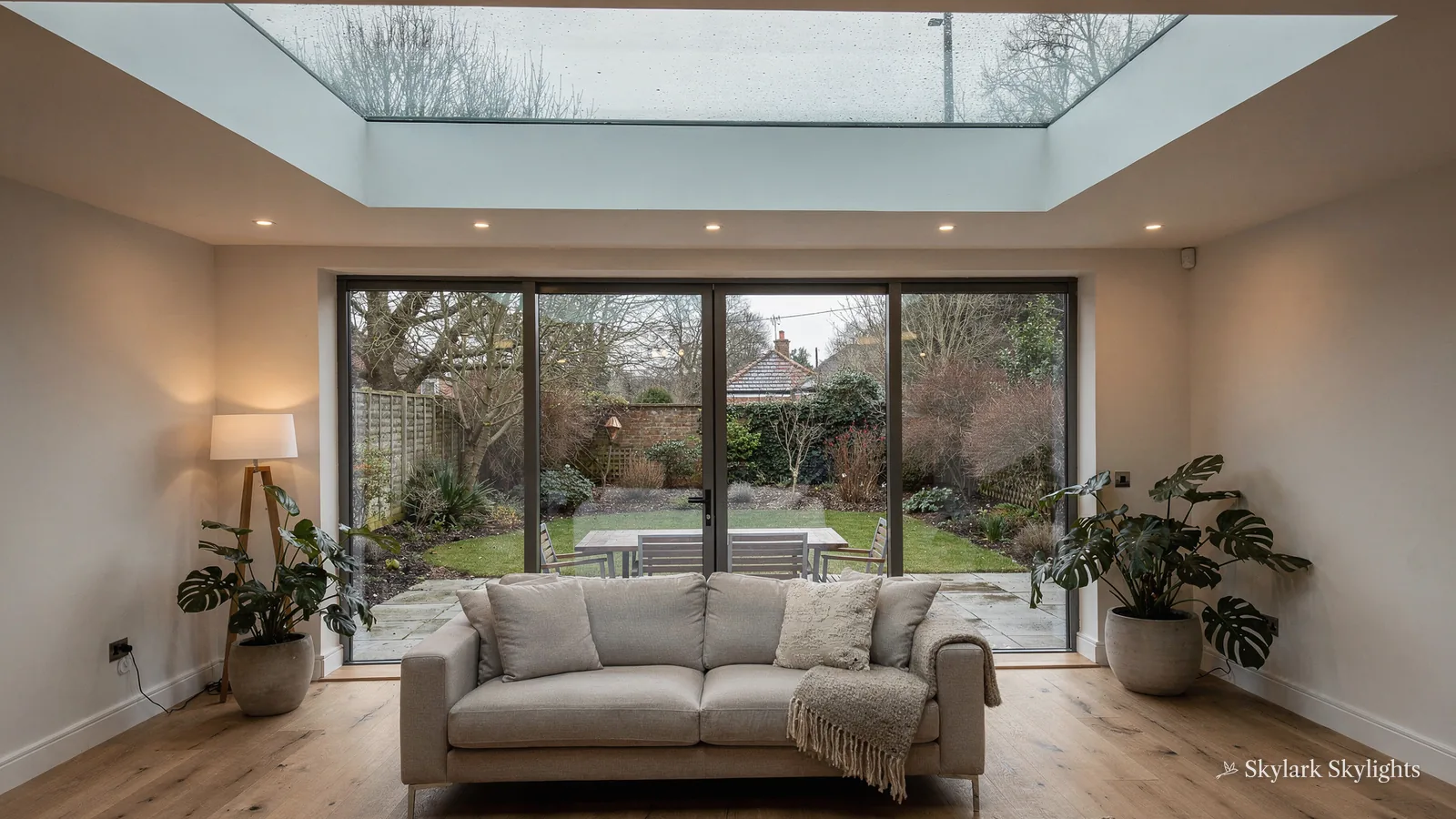
Two different falls
People mix up two separate things, so it helps to split them.
The first is the fall of the roof itself. A flat roof is never truly level. It is laid with a gentle slope towards a gutter, an outlet or a parapet drain, so rain leaves the surface rather than lying on it. Standing water speeds up wear on the covering, adds weight and tests every joint.
The second is the slope of the glass. Water sitting on a horizontal pane leaves a film, collects dirt in rings and, in winter, can freeze. A slight slope lets rain run off and wash the glass as it goes. Many flat rooflights are therefore made with the glass slightly angled or domed, or with a kerb that angles it. Flat glass on a perfectly level frame is not the aim.
What a rooflight pitch on a flat roof looks like
The slope is small. From the garden you may not notice it. From the side it shows as a slight tilt, a curved dome or a shallow ridge, depending on the style. A roof lantern has a pitched glazed roof of its own, which sheds water in several directions. A flat glass unit relies on a gentle slope across the pane.
The minimum slope for the glass is set by the rooflight maker, and it differs between products. We follow the maker's instructions, because the warranty and the weathertightness depend on them. Plain sheet laid dead flat is the case to avoid.
Setting the kerb to suit
A kerb on a roof that already falls will be higher on the downhill side unless it is built to compensate. The kerb is therefore set so the top is level, or deliberately tilted, as the unit requires. This is checked with a level and measured on the day, not guessed. The result is a tidy frame that does not look as if it is leaning. How the frame and covering meet is shown in the kerb guide.
Where the fall shows up
| Part | Needs fall? | Why |
|---|---|---|
| Roof surface | Yes | Drains rain away |
| Glass of unit | Yes | Sheds water, stays clean |
| Kerb top | Level or set | Seats the unit |
| Lantern roof | Built in | Pitched glazing |
When the roof has too little fall
Older flat roofs often sag in places, or were laid with hardly any fall. Water then lies in shallow ponds, and a pond next to a new kerb tests the upstand every time it rains. A rooflight does not cause this, but it does make it matter more.
On the survey we check how water moves across the roof and where it collects. Depending on what we find, the options are to improve the fall with tapered insulation when the roof is re-covered, to move the position of the opening, or to raise the upstand slightly. Where the roof problem is bigger than the rooflight, we say so plainly. How the survey works is set out in fitting one to a roof already built.
A rooflight does not change the rules for drainage. It simply makes it sensible to deal with a poor fall at the same time, since the roof is already being opened.
Cleaning and maintenance follow the slope
A properly sloped pane washes itself in rain, though dust and leaf litter still collect at the lower edge and corners. A quick wipe once or twice a year keeps the glass clear. A pane with no slope holds leaves and puddles and needs cleaning more often, and the dirt marks stand out from below, directly above your worktop or desk.
Flat rooflights over a room people use are best planned so that the spot, the glass and the slope work together. The position side is in choosing the position, and the glazing comparison helps if the material is still open.
Any new opening is notified to Building Control, which we take care of, and any rooflight in an existing home must come in at 2.2 W/m²K or better. The full range is on the flat roof rooflights hub, and the survey is free, so book your survey to have your own roof checked.
Fall, slope and standing water
Can a rooflight be fitted dead flat?
The kerb top can be level, but the glazing itself should still have a slope or dome so water sheds. Makers state the minimum for each product, and we follow it. A pane laid with no slope at all tends to hold water, collect dirt in rings and wear its seals faster.
Why is there a puddle on my flat roof beside the rooflight?
Usually the roof has too little fall, or has sagged, so water lies against the upstand. It is worth fixing because ponding wears every joint. We check how water moves across the roof on the survey and tell you what we find.
Does a roof lantern need a fall in the way a flat unit does?
The lantern has its own pitched glazed roof, so the glass sheds water in several directions. The roof around its kerb still needs a fall to drain. Both ideas apply, but the lantern builds the glass slope into its shape.
Can I fix a poor fall without re-covering the whole roof?
Sometimes a local fix is enough, such as raising the upstand or adjusting where water leaves. Often the better answer is tapered insulation laid when the roof is re-covered. We discuss both on the survey and put the chosen option into the fixed written quote.
Book your free survey
Where do you want the light? Tell us in the form: the worktop, the stair, the desk.
No obligation. We survey before we price.
We cover Derby and 30 miles around.