Guide · Misted rooflights · 9 min read
Replacing a Cracked or Yellowed Polycarbonate Dome
A tired dome tells you what it needs. Here is how to read it.
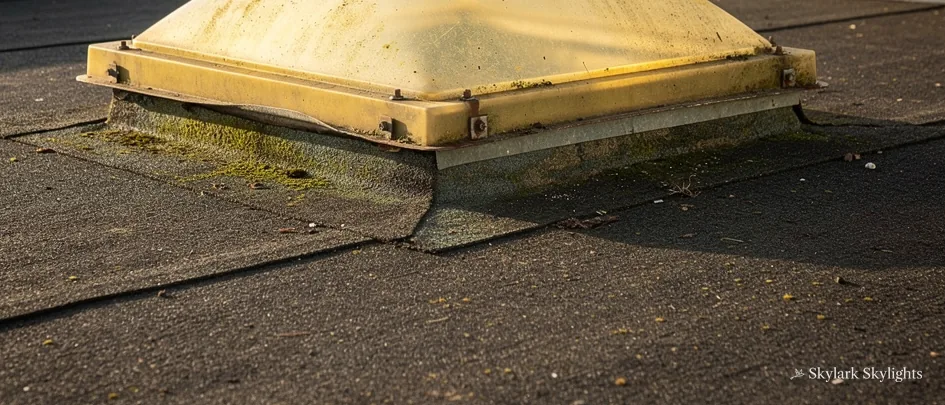
A plastic dome on a flat roof can look fine from the street and still be well past its best from underneath. Years of sun turn it yellow, then milky, then brittle, until a frosty morning or a heavy foot on the roof cracks it across. If you need to replace a polycarbonate rooflight dome, the dome itself is the easy part. The upstand it sits on, the flashing round it and the ceiling below are what decide whether the new one lasts. This guide covers the signs of a failing dome, what a replacement involves, and how it fits with our wider work on misted rooflight replacement.
Why a dome yellows, crazes and cracks
Polycarbonate is a tough clear plastic, and a new dome shrugs off a lot. What wears it out is sunlight. Ultraviolet light slowly breaks down the surface of the plastic, and heat cycles every day make it expand and shrink against its fixings. Over many seasons the clear skin loses its shine.
The first sign is colour. A dome that once looked like clean glass takes on a cream or amber tint. This discoloured skylight dome is not dirty, because scrubbing does nothing. The change runs right through the surface layer.
Next comes crazing, a fine web of hairline cracks that gives the plastic a frosted look and makes it scatter the light instead of passing it. Further on, the material turns brittle. A dome in this state can split at a corner screw or along the edge from a small knock, from a branch brought down in a gale, or from the weight of someone cleaning the gutters.
Many domes are twin-skinned, with an air gap between an outer and an inner dome. A crack in the outer skin lets damp and dust in. You then see the same kind of fogging that a misted glass unit has, though the cause is a split plastic and not a failed seal. The cure is to replace the dome, since the gap cannot be dried out and closed again.
If the room below has dimmed without any obvious damage, a yellowed dome is often why. The dome is letting less daylight through than it was designed to, and the spot beneath it is paying the price.
Reading the signs before you climb up
You can learn a lot from the ground and from the room before anyone goes on the roof. This matters, because a flat roof is not a safe place for a casual inspection. Plastic domes in particular can crack under a footstep, and the fall is through the ceiling opening and to the floor below.
From inside, look up at the light well lining and the ceiling around the opening. Brown rings, flaking paint or a patch of mould suggest water has been getting past the dome or the flashing. A drip after heavy rain points the same way. Look at the dome itself for a visible split, a missing fixing cap, or daylight showing around the edge where it should not.
From a safe place outside, perhaps an upstairs window or a ladder against the wall that you do not climb over, look for the colour and for any cracks. Look for moss or silt on the roof around the dome. Standing water on the felt or membrane next to the upstand suggests the roof falls the wrong way, which is a problem the dome did not cause but will inherit.
What you should not do is patch a cracked dome with tape or sealant. A patch hides the split from view, holds water in the crack and makes a proper replacement harder, because the new dome needs clean, dry surfaces to seal onto.
Photos help
A couple of clear photos from inside, showing the whole opening and the ceiling around it, tell us a good deal before we visit. Send them on WhatsApp on 07880 284133 along with the room and the spot you want lit, and we will say what is worth checking at the survey.
What sits under the dome
A dome does not sit straight on the roof. It is fixed to an upstand, sometimes called a kerb, which is a short box built up from the roof deck, with the roof covering dressed up its sides. The kerb might be timber, or it might be moulded plastic or GRP that arrived with the original dome as a single package.
The kerb is what the new dome seals onto, so it gets checked first. Timber kerbs can rot where moisture has been trapped at the bottom corner. Moulded kerbs can go brittle in the same way as the dome. The felt or membrane dressed up the outside has to be intact and well bonded, with no splits at the corners or lifting at the top edge.
When the kerb and covering are sound, a new dome can go straight onto the existing upstand. The old dome is lifted off, the seating is cleaned and checked, and the new dome is fixed and sealed so water runs away from it and cannot get underneath. That is a short job.
When the kerb is soft, cracked or the wrong height, there is no point sealing a new dome to it. The upstand is rebuilt or replaced, and the covering is renewed up and over the top so the junction is watertight. This is a bigger job, but it is the one that keeps the next dome from failing early.
Height matters because a flat roof ponds. Water that lies a few millimetres deep next to a low kerb will eventually find its way in. We look at the fall of the roof as part of the same visit.
Dome trouble and what it points to
| What you see | Likely cause | We check |
|---|---|---|
| Cream or amber tint | Sun has aged the plastic | Dome age, kerb condition |
| Fine web of cracks | Surface crazing | Whether the dome is brittle |
| Split at a corner | Fixing stress, impact | Kerb and fixings |
| Fog between skins | Outer skin breached | Both skins, edge seal |
| Stain on ceiling | Water past dome or kerb | Flashing, covering, fall |
What replacing the dome involves
A straightforward dome replacement is a contained job. We start by protecting the room below, because breaking the old seal sends dust and old sealant downwards. A dust sheet goes over the floor and furniture under the opening, and the spot beneath gets cleared.
On the roof, the old dome is released and lifted away. The upstand is cleaned back to a sound surface, and any loose felt or old sealant is removed. If the kerb needs work, this is the point where it is rebuilt or replaced. Then the new dome is placed, fixed through the flange and sealed so it is weathertight from the first night.
Inside, we check the light well and the opening for damp and tidy the edge where the old dome met the lining. Redecorating the plaster edge is a job for you or a decorator once the lining has dried out. A plain single dome on a sound kerb usually needs a day or two of roof work.
The fixed written quote covers all of it and stays put on the day. A 10-year workmanship guarantee, in writing, backs the job, and Building Control is notified by us where that is required.
Choosing the new dome
Not every dome is a like-for-like swap. Domes come in single, double and triple skins, in clear, opal and tinted finishes, and with or without an opening vent. A clear twin-skin dome passes the most light. An opal dome softens glare, which suits a bathroom or a room where you sit all day. A tint cuts the heat on a south-facing roof. We settle which suits the spot at the survey, and the choice is written into the quote so nothing is ordered on a guess.
Dome, or something else in the same opening
When a polycarbonate dome has failed, it is a fair moment to ask whether another kind of rooflight would serve better. The opening is already there, and the roof is going to be touched anyway.
A flat glass rooflight gives a clearer view of the sky, holds its looks for longer and usually insulates better than a plastic dome. A pitched-glass roof lantern is a bigger step, suited to a wider opening over a table or kitchen island, and it needs a larger kerb and more structure. A dome with an opening vent gives ventilation in a bathroom or utility room without any glazing change.
The Building Regulations shape the choice. For an existing dwelling, Table 4.2 of Approved Document L (2021) holds a replacement rooflight to 2.2 W/m²K, and a roof window to 1.4 W/m²K, with band B in the Window Energy Rating scheme as an alternative. Even a straight swap is controlled work under Part L, which means the unit going in has to reach the figure for its kind. We notify Building Control wherever the work calls for it.
Planning rules are the other thing to check if the new unit is a different shape or size. Our planning guide explains what to look at for houses, flats, listed buildings and conservation areas.
If the real trouble in your roof is a pane of glass rather than a plastic dome, our guide on the choice between fresh glazing and a complete new unit covers that case.
What decides the size of a dome job
- Condition of the upstandA sound kerb saves time; a rotten one must be rebuilt.
- Dome size and skinsLarger and multi-skin domes weigh more and cost more to make.
- Roof covering around itWorn felt or membrane may need renewing up the kerb.
- Access to the roofAwkward access needs more time and extra safety measures.
- Choice of finish or ventOpal, tinted and opening domes are made to order.
Dome replacement, question by question
Can a yellowed dome simply be cleaned?
No. The colour is in the plastic, not on it, because ultraviolet light has aged the surface layer. Cleaning removes dirt but leaves the tint, and a scrubbed surface can scratch and look worse. A dome that is yellow, crazed or brittle needs replacing, not polishing, and the earlier it is changed the less the kerb beneath it suffers.
Do you always have to replace the kerb as well?
No. We inspect the upstand and the covering at the survey. A sound kerb takes the new dome directly. A soft, cracked or wrongly sized one is rebuilt or replaced so the junction can be sealed properly. You see which it is in the written quote.
Is it safe to stand on the dome to check it?
Never. A plastic dome is not made to carry a person and an aged one is brittle. Look from inside and from a safe place outside, and leave roof work to us. If you want a rooflight you can walk across, our walk-on glass units are made for that.
How long does a dome replacement take?
A plain single dome on a sound kerb usually needs a day or two of roof work. Rebuilding a kerb or renewing the covering adds time, and the survey tells you which applies. The written quote is fixed.
Will the new dome let in more light than the old one?
Almost certainly, if the old one had yellowed. A clear new dome passes more daylight than a tinted old one. Opal and tinted domes pass less on purpose, to soften glare or heat. We choose the finish with you at the survey, based on the room and the spot beneath it.
Book your free survey
Where do you want the light? Tell us in the form: the worktop, the stair, the desk.
No obligation. We survey before we price.
We cover Derby and 30 miles around.