Answer · Walk-on rooflights
Are Walk-On Rooflights Slippery?
The short answer
Smooth, untreated glass can be slippery, especially when wet, which is why walk-on rooflights are normally supplied with a grip finish on the top face. The finish is etched, printed or fused into the glass, and it gives shoes something to hold. How much grip you need depends on whether the glass is indoors or out, how often it gets wet and who walks on it. The finish is picked on site visit, with the actual spot in front of us.
Glass can be slick, so the surface is made to grip.
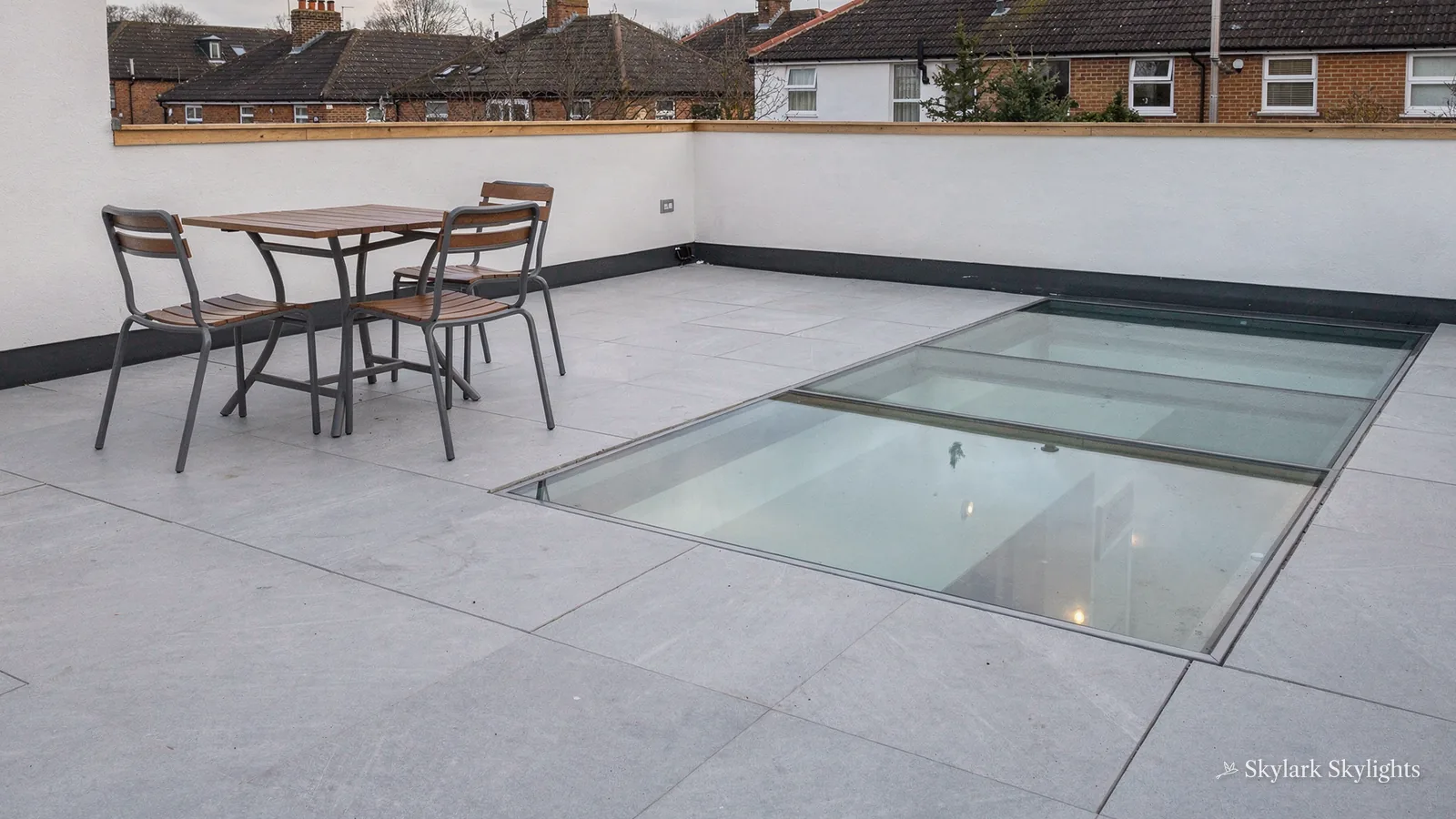
Why plain glass is slippery
Float glass has a very smooth, hard surface. Add a film of water, a dusting of soap or the damp sole of a shoe, and there is little friction between the two. That is true of a glass shower screen, a glass shop floor and a glass rooflight alike. It says nothing about the strength of the panel, only about the surface texture.
Socks and bare feet on dry glass indoors usually grip better than wet shoes on glass outside, but even dry glass can feel unfamiliar. Many people hesitate the first time they step onto a clear floor, and a textured surface helps that too, because the grip can be felt through the foot.
So the useful question is not whether glass can be slippery but what has been done to the surface of this particular rooflight, and whether that suits the way the spot will be used. A glass floor over a dry landing and a glass step in an outdoor path are different jobs.
The ways a rooflight is given grip
An anti-slip glass rooflight has a surface treated in one of a few established ways. Each changes the look slightly, and each suits some uses better than others.
Etched or acid-treated surfaces
The top face is treated chemically or by sandblasting so it becomes a fine, frosted texture. It reads as a translucent, softly obscured surface. It is a good all-round finish for indoor floors and gives a pleasant, even grip. The frosting also softens the view down, which can be useful for privacy.
Printed or fritted patterns
A ceramic ink in a pattern of dots, lines or a grid is printed on the glass and fired into it, so it becomes part of the surface. The pattern leaves clear gaps between the printed areas, which keeps more of the view and more of the daylight than an overall frost. It is widely used for outdoor and wet areas, and the pattern density can be adjusted to balance grip against clarity.
Textured or profiled glass
Some panels use glass with a small pressed texture. It gives a reliable grip and hides marks, though it reduces the clarity of the view through the glass.
Whichever route is used, the finish should be on the top face of the panel, where the foot lands, and it should be specified for the test condition it is meant to meet. Ask for the slip rating of the actual finish instead of relying on the description of it.
Grip finishes and where they suit
| Finish | Look | Best for |
|---|---|---|
| Etched | Soft frosted | Indoor floors, privacy |
| Fritted dots | Clear gaps | Terraces, wet areas |
| Fritted lines | Directional | Steps, paths |
| Pressed texture | Pattern, less clear | Busy outdoor use |
How slip resistance is measured
Slip resistance is tested, not guessed. A common method is the pendulum test, in which a rubber-soled arm swings across the surface and the drag it feels is read off a scale. A higher reading means more grip. Tests can be run wet or dry, with a standard rubber, and the result is reported as a value for that finish.
The figure is useful for comparing finishes on the same basis. It does not describe how any one person's shoe will behave, since sole material, wear and what is on the glass all matter. Treat it as a guide to a finish's character, and ask for the tested value for whichever finish is proposed, not just the product name.
Different places need different levels. A glass patch in a dry internal floor can use a gentler finish than a panel in an external terrace that is rained on, frosted over and left with leaves on it. We aim to match the finish to the wettest realistic day for the spot, not the driest.
Inside, outside and in between
Where the glass sits changes the answer.
Indoors
A walk-on rooflight in a hall, landing or kitchen floor sees dry feet most of the time. An etched finish is often enough, with occasional spills wiped up like any other floor. A kitchen floor that gets wet more often might use a bolder pattern.
Outdoors
On a roof terrace or garden path the glass gets rain, frost, leaf fall and algae. These make any hard surface slick. The finish here is more deliberate, usually a fritted pattern with enough coverage to give a reliable grip when wet. Regular sweeping and cleaning matters as much as the finish itself, because a film of moss or leaf mould defeats the best texture. Our guide to terraces and balconies covers how the surrounding surface is kept clear.
Steps and slopes
Glass on a step or a sloped surface needs more care, since a slip there has further consequences. In those places we prefer a stronger finish, and we suggest a nosing or edge detail that gives the foot something to find.
What we settle at the survey
Choosing a grip finish is part of the free survey, not an afterthought at the glass order. We look at the spot, ask whether it is wet or dry, indoors or out, and who will walk on it, including children, older relatives and anyone carrying a laundry basket or a tray. The finish, its tested slip value and the way it looks from above and below are all written into the fixed quote.
It is worth saying plainly that a grip finish reduces slipping, it does not remove all risk. A clean surface, sensible footwear and some care on a wet day still matter, as they do on any outdoor floor. If you want the wider picture of what we fit, the walk-on rooflights page sets it out, and the survey form is the way to start.
Frames and surrounds count too. A smooth metal frame edge or a polished threshold beside the glass can be as slick as the glass itself, so the finish of the whole walking area is considered together.
Grip, cleaning and glass
Does an anti-slip finish make the glass look cloudy?
An etched finish does, because it is a frost. A fritted dot pattern leaves clear gaps, so the glass looks patterned instead of cloudy and more daylight comes through. We show the options against your spot so you can choose how clear you want the view to be.
Will the grip wear off over time?
Fired ceramic patterns and etching are part of the glass, so they last far longer than a coating. Abrasive cleaning and trapped grit wear any surface, so we recommend gentle cleaning and sweeping the surround to keep grit off the glass.
Can I add anti-slip to an existing rooflight?
Adding grip to existing glass usually means a stick-on film or coating, which is less durable than a finish built into the panel. If an old walk-on unit is slippery or worn, replacing the glass with a treated panel is often the better route, and we can survey it.
How should I clean a textured rooflight?
Use warm water, a soft brush or cloth and a mild glass cleaner. Avoid abrasive pads and strong solvents. Rinse off soap residues, since a thin film of soap on glass is slippery in its own right.
Do I need a grip finish on a floor that is only ever dry?
It is still sensible. Clear glass feels slick underfoot, and spills and damp shoes happen even in dry rooms. A light etch costs little in clarity and gives people confidence stepping onto the glass.
Book your free survey
Where do you want the light? Tell us in the form: the worktop, the stair, the desk.
No obligation. We survey before we price.
We cover Derby and 30 miles around.