Answer · Electric opening rooflights
What Happens to an Electric Rooflight in a Power Cut?
The short answer
In a power cut, a mains-powered electric rooflight stops where it is. It will not open or close until the supply returns, unless the system has a battery backup or a manual override. If it was left open, the sash stays open. That is why the backup is worth deciding at the survey, not after the first outage.
It stays where it is, unless you chose a backup.
What happens, step by step
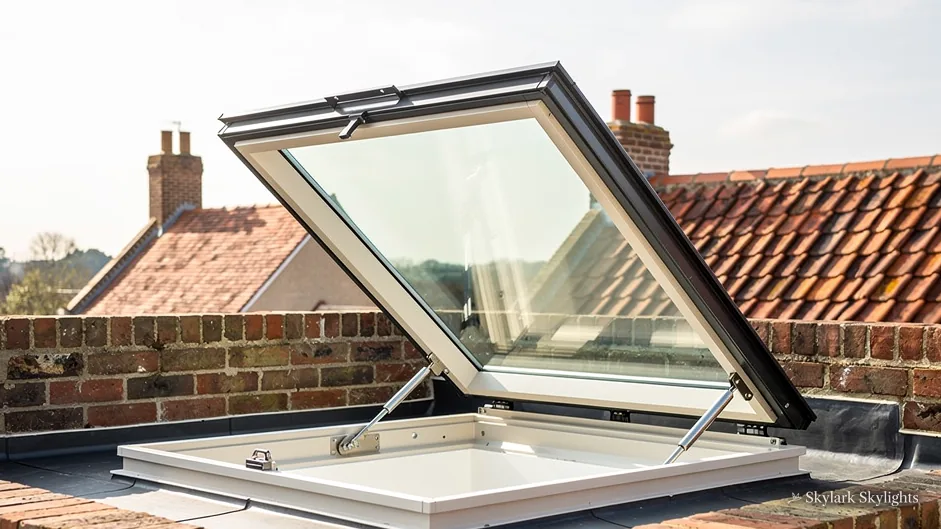
An electric rooflight has a motor that moves the sash and a control box that tells the motor what to do. Both need power. When the supply fails, the control box goes dead, the motor stops and the sash stays wherever it was at that moment. If it was closed, it stays closed, and the weather stays out. If it was open, it stays open.
Nothing breaks. The unit is not damaged by a power cut, and when the supply comes back, it carries on as normal. The remote and wall switch work again. On some systems, the control box remembers its settings through an outage, and on others it may need to be re-set, which the instructions for the chosen model explain.
The real concern is the open-sash case. A unit that was left ajar for ventilation, with a storm on the way, cannot close itself if the supply fails at the wrong moment. The rain sensor sends its signal, but there is no power to act on it. That is a rare combination, but it is the reason this question comes up.
The ways round it
There are three sensible answers, and they can be combined.
A battery backup
Some control systems can be fitted with a rechargeable battery that holds enough charge to close the sash if the mains fails. The battery sits beside the control box and tops up from the supply. It is a quiet protection that you rarely notice until the day it matters. Whether it is available depends on the make and model, so it is a question for the survey.
A manual override
Some electric rooflights can be moved by hand if the motor is disengaged, using a handle, a key or a release lever. Others, with a chain or spindle drive, cannot be forced without damage, and the manufacturer's instructions say what is safe. If a manual override matters to you, choose a unit that offers one and ask to see how it works.
A solar or battery-driven unit
A solar-powered unit does not depend on the house supply, so it keeps working while the mains is out, as long as the battery has charge. The solar answer looks at it in detail.
Options when the mains fails
| Option | In a power cut | Check first |
|---|---|---|
| Mains only | Stops where it is | Is it left open? |
| Battery backup | Can close the sash | Is it offered? |
| Manual override | Moves by hand | Handle or key |
| Solar and battery | Carries on moving | Battery charge |
Habits that make an outage a non-event
A power cut can come without warning. Sometimes it follows a storm warning, and often it arrives in bad weather. A few simple habits take the risk out of it.
If you are going out and rain is forecast, close the unit before you leave. If there is a storm on the way, close it for the evening. Leave it open only for a narrow gap when you are in the house, so that if the supply fails you can deal with it. Know where the manual release is, if there is one, and keep any key or handle where the household can find it.
It is also worth thinking about where the water would go. A sash left open over a hard floor causes little trouble. The same opening over a worktop, a landing carpet or a bathroom with fittings underneath is a bigger concern. This is another reason the position of the rooflight matters: the spot below it decides how much a stuck-open window could cost you.
A rain sensor still earns its place, even though it cannot beat a power cut. It handles the usual case, which is rain with the power on, and it does so without any effort on your part. The sensors and controls guide shows how it fits into the controls.
Deciding at the survey
This is a choice best made before the unit is ordered. The free survey lets us study the room, your usual standing place and the roof together. We can then talk through which products offer a backup or override and whether those are worth having in your case. A rooflight over a small landing that is rarely opened needs less protection than one above a kitchen worktop that is vented every day.
Forming a new opening is a structural change to the roof, and that means Building Regulations approval, obtained through the council or a registered building control approver. The notification is ours to make when it applies, and fitting follows the regulations in force. Direct swaps must meet the thermal limit for their type.
Our written quote is final, and a 10-year workmanship guarantee comes with the work. For the bigger picture, our electric opening rooflights page covers the whole system. Ask for a survey through the quote form, or send us a WhatsApp on 07880 284133.
When the lights go out
Will a power cut damage my electric rooflight?
No. The unit simply stops moving until the supply returns, then works as before. Some control boxes need their settings checked afterwards. The instructions for your model explain whether that applies, and it is usually a simple reset.
Can I close an electric rooflight by hand?
On some models, yes, using a handle, key or release lever. On others, forcing the sash can damage the drive. Check the manufacturer's instructions for your unit, and ask about the override before you choose one.
Does a battery backup close the rooflight automatically?
On systems that offer one, the battery holds enough charge to drive the sash closed when the mains fails, and a rain sensor can still trigger it. Not every product offers it, so ask at the survey.
Is a closed rooflight still weatherproof in an outage?
Yes. A closed unit is held by its seals and flashing, not by the motor. The power only matters for opening and closing, so a rooflight shut when the cut begins stays shut.
Does a solar-powered rooflight keep working in a power cut?
Usually yes, because it has its own panel and battery rather than relying on the house supply. It keeps working while the battery has charge, so a long run of dark days with heavy use could still leave it low.
Book your free survey
Where do you want the light? Tell us in the form: the worktop, the stair, the desk.
No obligation. We survey before we price.
We cover Derby and 30 miles around.