Answer · Energy efficient rooflights
How Do You Stop Condensation on a Skylight?
The short answer
You stop skylight condensation by lowering the moisture in the room, warming the glass, or replacing the unit if its seal has failed. Which one applies depends on where the moisture sits. Droplets on the room side point to damp air meeting a cold pane. Mist trapped between the panes means the sealed unit has failed and needs replacing.
Damp on the glass has three causes, and one real fix each.
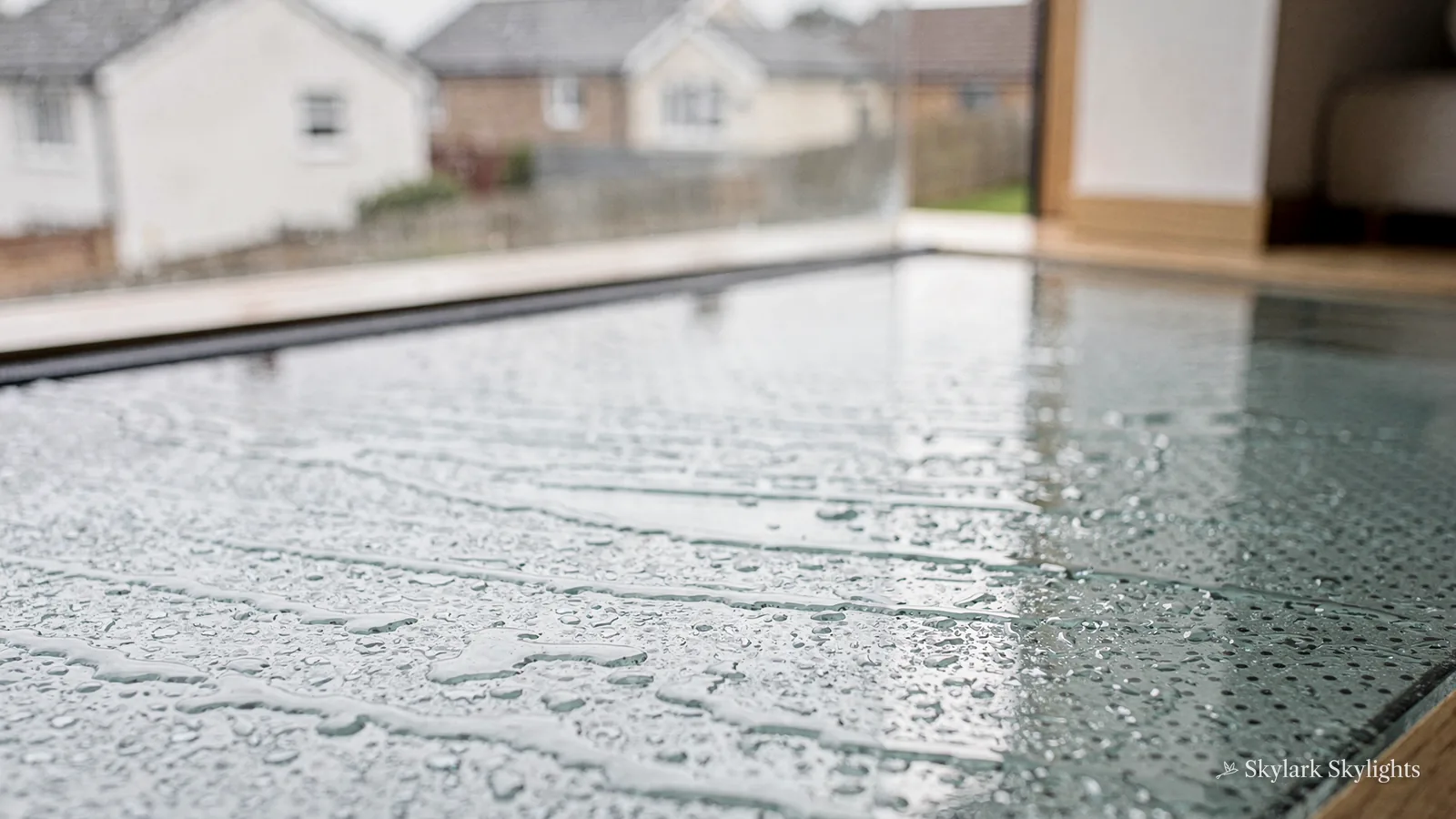
First, find which side the damp is on
The place the moisture appears tells you what is wrong, and you can check it in a minute. Wipe the glass on the room side with a dry cloth.
- If the droplets wipe away, the damp is on the inside face. This is ordinary condensation from room air touching a cold surface.
- If the mist stays after you wipe, and sits between the panes, the sealed unit has failed. Moist air has got into the gap and the gas fill has gone.
- If droplets form on the outside face, usually on a clear cold morning, that is the glass doing its job by staying cold on the outside. It is not a fault.
The first is a room problem. The second is a product problem. The two have different fixes, so it is worth being sure which one you have.
Condensation on the room side
Warm air carries water vapour from cooking, showers, drying clothes and breathing. When that air touches a surface colder than its dew point, the vapour turns to droplets. The coldest part of a rooflight is the glass and, most of all, its edge, so that is where it appears first.
Three habits reduce it, and they work together.
- Cut the moisture, with an extractor fan in the kitchen and bathroom, lids on pans, and clothes dried outside the main living space.
- Move the air, by opening the rooflight a little, which also lets damp air escape. An electric opening unit makes this easy where the window is out of reach. See electric opening rooflights.
- Warm the glass, which is where the product matters.
Bathrooms and kitchens under a rooflight see the heaviest moisture, since steam rises straight to the glass above. An older unit with a metal spacer and no coating has a cold edge, so it mists readily. A modern build with a low-emissivity coating, gas fill and a warm edge spacer keeps its inner face warmer and resists condensation in conditions where an older unit would mist. Our guide to rooflight U-values explains why a better figure means a warmer pane.
Mist between the panes
A sealed double glazed unit is meant to stay dry inside for its whole life. When the seal around the edge fails, moist air gets in, and the unit mists or shows a milky film that you cannot wipe off. It is also losing insulation, since the gas has leaked out.
This cannot be cleaned or dried out for good. The unit is beyond repair and has to be replaced. The new glass must meet the current heat loss limit for its class, so it will normally outperform the failed unit. A like-for-like swap is a controlled fitting, and our team files the Building Control notification where one is due. The full process is covered on our misted rooflight replacement page.
What not to do
A few habits make it worse, and each is easy to stop. Treat them as a short checklist before you blame the glass. Sealing up every vent to save heat traps the moisture. Hanging wet washing in a room with a rooflight above sends vapour straight to the cold glass. Wiping the glass without cutting the cause just resets the clock, and the droplets are back within hours. Sealant or drilling a failed unit does not restore it either.
Keep the room's humidity moderate through the cold months, and aim to have the rooflight clear by mid-morning once the day warms. A cheap room hygrometer shows the humidity at a glance, and a steady reading in the comfortable middle range tells you the room air is not the problem. If condensation is heavy at the rim of an otherwise sound unit, the cause is often a cold frame or edge. In that case a better glazing build is the lasting answer, and our comparison of double or triple glazed rooflights shows how the options differ. Whether the loss through the glass is a worry in itself is covered in our answer on whether skylights lose heat.
Getting it looked at
Not sure which kind of damp you have, or whether the unit underneath it is still sound? The free survey will show you, with the room, the spot under the rooflight and the roof all checked before a price appears. If the unit needs replacing, the fixed written quote stays as written, and a 10-year workmanship guarantee in writing covers the job.
A photo and a few words on the form is enough to start, or use WhatsApp on 07880 284133. For the wider picture, read about energy efficient rooflights.
Condensation, in short answers
Is condensation on my rooflight a sign it needs replacing?
Not always. Droplets on the room side that wipe away usually mean damp air meeting a cold pane, and can be reduced with ventilation. Mist trapped between the panes that will not wipe off means the seal has failed, and then the unit needs replacing.
Why is there condensation on the outside of my skylight?
On a clear, cold morning the outer pane drops below the dew point of the air and collects dew. It is a sign the glass is insulating well, because the inner heat is not reaching it. It is harmless and clears as the day warms.
Will opening the rooflight help with condensation?
Yes. Letting a little damp air out reduces the moisture available to condense, which helps most in kitchens, bathrooms and bedrooms. Combine it with extractor fans and drying clothes elsewhere for the best effect.
Book your free survey
Where do you want the light? Tell us in the form: the worktop, the stair, the desk.
No obligation. We survey before we price.
We cover Derby and 30 miles around.