Answer · Sun tunnels
Are Sun Tunnels a Good Idea?
The short answer
Yes, a sun tunnel is a good idea for a small, dark, internal space with a loft above it. Landings, hallways, bathrooms and cloakrooms are the usual winners. It is a poorer choice where you want a view, fresh air or a lot of light for a large room, because a tunnel gives modest, diffused daylight. The honest answer turns on the dark spot and the roof above it, and a free survey settles both.
Good in the right dark corner, poor in the wrong one.
What a sun tunnel does well
A sun tunnel brings daylight into a space that has no outside wall. A dome on the roof gathers light, a tube leads it through the loft and a diffuser fans it across the ceiling. There is no window to overlook, no glazing to open and no large hole in the ceiling.
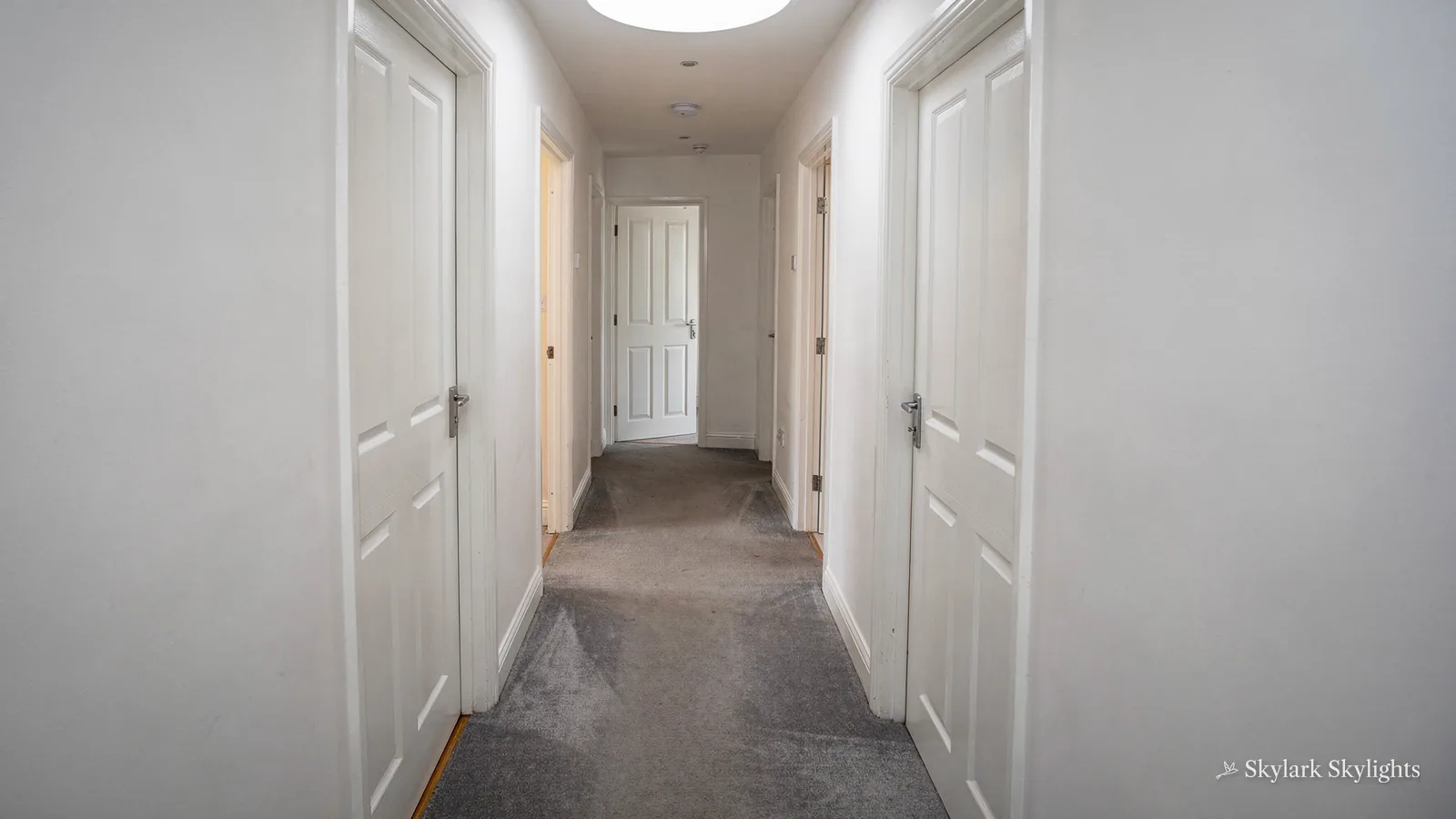
That makes it ideal for the spaces a normal window cannot reach. A dark landing at the top of a stairwell. A windowless bathroom. A narrow hallway between closed doors. A utility room tucked into the middle of the plan. In each case the daylight lands on a particular spot, and the room feels different from the moment the diffuser is fitted.
The roof opening is small, which keeps the work compact. A simple single unit keeps us on the roof for a day or two. The ceiling opening is also small, so the finish inside is tidy and the loft insulation is largely undisturbed.
Another quiet strength is how little a tunnel asks of the house. There is no change to the room's walls, no new window to dress and no extra heating loss through a large pane. The ceiling gains a plain, neat disc, and the rest of the room stays as it was.
Where a tunnel falls short
A tunnel is a source of light, nothing more. It does not open, it gives no view of the sky and it does not ventilate. If a room needs fresh air, you need an opening roof window or an electric opening rooflight, with a tunnel as a companion if at all.
The light is also softer and smaller in scale than the light from a full rooflight. A tunnel suits a hallway or a bathroom. It will not turn a large, dark living room into a bright one, and a room of that size usually calls for a roof lantern or a larger flat rooflight instead.
Finally, a tunnel needs a route. If there is a room directly above the space, there is no loft to run the tube through, and the survey will look for another spot. A long, twisting route also loses light, so the loft shape matters as much as the room.
The case for and against
In its favour
- Lights rooms with no outside wall
- Small roof and ceiling openings
- Frosted, so fully private
- Quick to fit on a simple roof
Against it
- Gives light only, no view
- Does not open for air
- Needs a loft route above
- Modest light for big rooms
Sun tunnel pros and cons in practice
Put the pros and cons against the spot you have in mind. If the spot is the middle of a landing, the top of a stair or the space above a basin, the pros dominate. The light falls where you stand, and the cons barely apply, because you were not expecting a view from a landing.
If the spot is a kitchen worktop in a large extension, or a desk in a loft bedroom, the cons take over. Those places want more light, a sky view or an opening for air. A roof window or a lantern does that job better.
There is also the matter of cost. A tunnel is usually the more modest product, and the costs guide sets out what moves the price. No figure comes before a visit to the room and the loft. A free survey comes first, then a fixed written quote.
A fair test before you commit
Stand in the space on a bright morning with the lights off. If you would be happy with a gentle, even glow where you stand, a tunnel will satisfy you. If you find yourself wishing for a view of treetops or a window to throw open, you are describing a skylight instead.
Then look up. If you can picture a loft above that ceiling, with nothing but a roof over it, the route exists. If a bedroom sits there, it does not. Those two quick checks answer most of the question before anyone visits. The survey confirms them properly, and it also looks at the roof outside, where the dome would sit clear of shade and awkward roof features.
It is also worth thinking about the long term. A dome and tube need little attention once fitted, and an old, yellowed dome can be replaced without disturbing the tube in many cases. That is part of why a tunnel is a sensible choice for a space you will use for years.
How to decide
Start with the spot, not the product. Where do you stand when the room feels dark? Is there a loft directly above it? Do you want light only, or light plus a view and air? If the answers are a small internal space, a loft above and light only, a sun tunnel is a good idea.
If you are torn between a tunnel and a rooflight, our guide to sun tunnel or skylight sets the two side by side. To see how bright a tunnel can be, read how bright the glow really is.
When you are ready, the survey form is the place to start. Every job begins with a free survey, followed by a written quote that stays fixed. Our full sun tunnels guide covers the rest.
Before you decide on a tunnel
Are sun tunnels cheaper than skylights?
A tunnel is often the more modest product, because the roof and ceiling openings are small. The total still depends on the roof covering, the length of the run and the finish. A quote follows the free survey, and it is a written, fixed figure.
Do sun tunnels leak?
A properly flashed dome on a well-prepared roof is made to stay watertight. The flashing is chosen to suit the roof covering, and the junctions are sealed. A 10-year workmanship guarantee is given in writing.
Will a sun tunnel make the room cold?
The tube passes through the loft insulation, so it is sealed and the insulation is laid back around it. A correctly fitted unit should not create a cold spot. The survey checks the loft before we plan the run.

Book your free survey
Where do you want the light? Tell us in the form: the worktop, the stair, the desk.
No obligation. We survey before we price.
We cover Derby and 30 miles around.