Answer · Sun tunnels
How Much Light Does a Sun Tunnel Give?
The short answer
A sun tunnel gives a soft, useful glow, enough to light a landing, hallway or bathroom in daylight, but not enough to light a large room. Exactly how much depends on the width of the dome, the length and straightness of the tube, the type of tube and the weather. A short, straight run delivers the most. Every extra metre or bend takes a little away.
Light output depends on the dome, the tube and the drop.
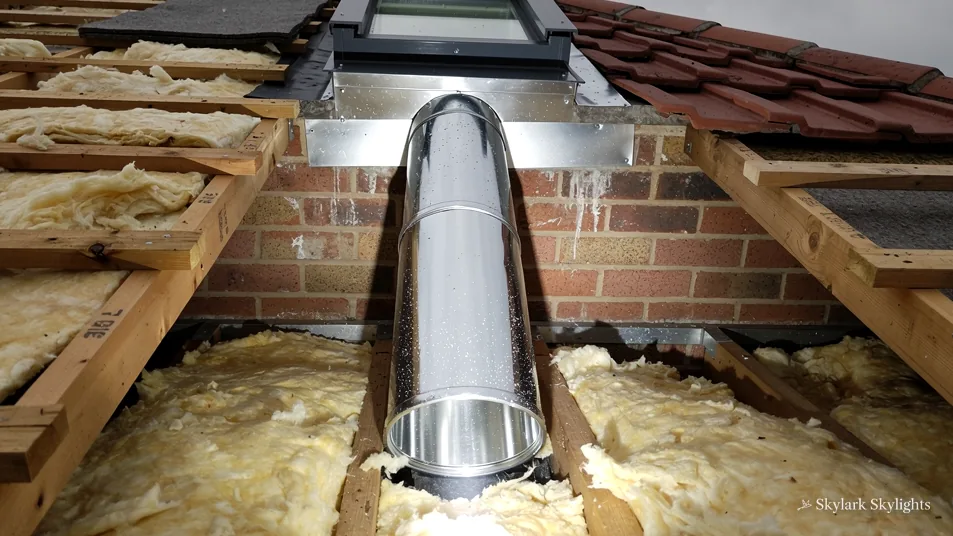
What sets the light output
Five things decide how bright the diffuser looks. The first is the dome and tube width, because a wider opening gathers more daylight. The second is the length of the run, because light bounces down the tube and loses a little at every bounce. The third is the number of bends, since each elbow costs more than a straight stretch. The fourth is the tube itself, where a polished rigid tube carries more than a ridged flexible one, which rigid or flexible sun tunnels covers in detail. The fifth is the roof, including the direction it faces and anything that shades it.
None of these gives a fixed number you can promise, and we do not quote one. Daylight changes by the hour. What we can do is plan the run so that these five work in your favour.
Think of the system as a chain. Light enters at the dome, travels down the tube and leaves at the diffuser. The chain is only as strong as its weakest link. A large dome feeding a long, bendy flexible tube wastes much of its advantage. A modest dome over a short, straight rigid drop can outperform it. That is why we look at the whole run and not just the size of the dome.
Weather, time of day and season
A sun tunnel works on daylight, not only direct sun. On a bright, clear day the diffuser glows strongly. On a grey day it still gives light, only less of it. In the evening, when the sky darkens, the glow fades with it. In winter the sun sits lower and the days are shorter, so the output is lower than in summer.
A roof that faces south collects light for more of the day, while a north-facing slope gives a gentler, steadier light. Trees, a taller neighbouring building or a chimney can shade the dome at certain hours. We look at all of this from outside on the survey, and where a clearer part of the roof is available we say so.
Why the diffuser matters
The diffuser at the ceiling spreads the light so it does not arrive as a single hard beam. A good diffuser makes the glow even, avoids glare and hides the tube. Some include a prismatic pattern that throws light sideways, so the corners of a small room are not left in shade. The shape and fit are chosen with the ceiling in mind.
What brightens or dims the glow
- Wider dome and tube
- gathers more daylight
- Shorter run
- fewer bounces, more light
- Straight route
- no elbows to lose it
- Rigid tube
- cleaner reflections
- Shade on the roof
- lowers it at that hour
How much room it can light
A tunnel suits a small space. A landing, a short hall, a bathroom or a cloakroom is well within its reach. The light falls most strongly directly below the diffuser and softens towards the edges of the room.
A bigger room, such as a long hallway or a large kitchen, may need two tunnels spaced along it, or a different product. A roof window or flat rooflight lets in more because the glass sits directly over the room. The page on sun tunnel or skylight compares the two.
Paler walls and ceilings help, because they bounce the light further into the room. A dark floor and dark walls soak it up, so the glow looks smaller than it is.
Judging it by the spot
Instead of asking for a number, ask what you want to see. Do you want to read the post on the landing without switching on the light? Find the sink in a windowless bathroom on a dull morning? See the bottom step clearly? These are practical tests, and a tunnel planned for the spot passes them.
A tunnel will not rival a wall of glass, and it is not meant to. It turns a gloomy internal space into a pleasantly lit one. That is a real change for a small job.
If the space turns out to need more than a tunnel can offer, we say so at the survey and suggest a rooflight, a roof window or a second tunnel instead. We would rather tell you before the work than after it.
Keeping the glow bright
A clean dome gathers more light, so a rinse from time to time keeps it clear. Leaves and moss on the dome reduce the light, and an old, yellowed dome dims the result. If a dome has crazed or discoloured, replacing it brings back the original brightness.
Getting the most from one
The best gains come from planning, not from specification. Put the diffuser above the spot you use most. Keep the loft run short and straight. Choose the tube to suit the drop. Pick a part of the roof clear of shade.
All of this is checked on the free survey, and the written quote that follows is fixed. Start with the survey form, and see our sun tunnels guide for the wider picture.
Questions on brightness
Does a sun tunnel work on a cloudy day?
Yes. It runs on daylight, not only direct sun. On an overcast day the glow is softer, but the landing or bathroom below is still brighter than it would be without it.
Is a bigger tunnel always better?
A wider tube gathers more daylight, which helps over a long drop. But the loft must have room for it, so the survey measures the space before choosing a width.
Can I add a light to the tunnel for evenings?
Some diffusers take a light fitting, so the same opening can serve at night. Ask at the survey if that matters to you, and we will say what suits your ceiling.
Book your free survey
Where do you want the light? Tell us in the form: the worktop, the stair, the desk.
No obligation. We survey before we price.
We cover Derby and 30 miles around.